
London’s Tube network is many things to many people; a sweaty commute in August, a surprisingly effective shortcut from Paddington to Canary Wharf, a place where you’ll read four pages of a novel you’ve been meaning to finish since 2019. But for advertisers, it’s something else entirely – one of the most captive audiences anywhere in the country, sitting still for minutes at a time with nowhere particular to look except the carriage wall.
In an era where every digital ad can be skipped, blocked, or simply ignored while you open another tab, physical advertising in enclosed spaces has quietly held its ground. And the Tube, specifically, has a quality that’s genuinely hard to replicate elsewhere.
The Captive Audience Problem
Most advertising competes for attention. A billboard on the A40 gets maybe two seconds of glance-time before the driver’s eyes are back on the road, and a sponsored post on Instagram is gone the moment someone swipes. But passengers on the Central line between Holborn and Liverpool Street? They’ve got six or seven minutes and the visual options are, frankly, limited. That’s the thing about Tube advertising that people underestimate when they’re only thinking about reach numbers. It’s not just about how many people see an ad, it’s about how long they sit with it.
Research across the outdoor advertising industry consistently shows that underground placements generate longer dwell times than almost any other format. Passengers read things twice, sometimes three times, out of sheer boredom, and that repetition does something to memory that a half-second glance simply doesn’t.
Who Actually Uses It and Why
There’s a perception that tube advertising is the preserve of big brands with serious budgets, and it’s true that you’ll see plenty of Netflix launches and broadband providers plastered across Waterloo, but the format is more accessible than most people assume. Local businesses, subscription services, charities, and mid-sized consumer brands have all found it viable, particularly if they’re targeting London-based customers specifically.
The network itself matters too. Oxford Circus, King’s Cross, Canary Wharf, and Bank carry very different demographic profiles, and a half-decent media buyer will match the placement to the audience. A fintech startup probably isn’t best served by advertising at Heathrow Terminal 4 exclusively, whereas a luxury travel brand probably is. That level of targeting isn’t something you associate with traditional outdoor advertising, but the Tube genuinely allows for it.
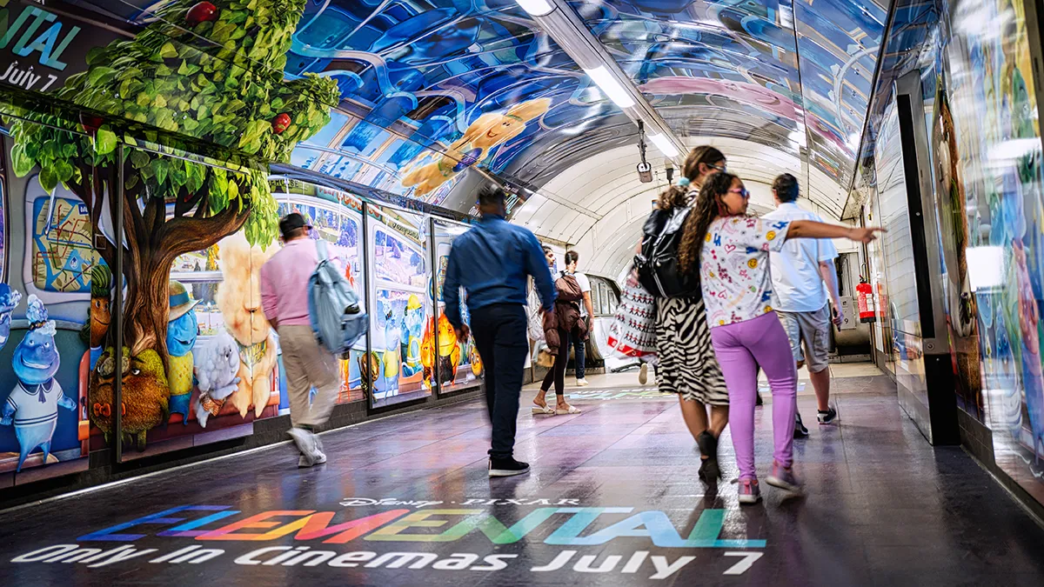
Format variety helps as well. You’ve got cross-track posters, escalator panels, 6-sheet formats inside carriages, digital screens at busier stations. Each one suits a different message and budget, so brands aren’t locked into one approach.
The Creative Challenge Nobody Mentions
Getting seen is only half the job. Creativity that works brilliantly on a phone screen or a full-page magazine spread doesn’t automatically translate to a carriage panel. The proportions are different, the reading distance changes, and the ambient light in underground stations varies wildly between something like Canary Wharf and some of the older sub-surface stations where it’s genuinely quite dim.
Brands that nail it tend to keep things simple. Strong contrast, minimal copy, one clear idea. The ones that cram in six selling points and a QR code (which, to be fair, is increasingly scannable if you’ve got a signal) often end up with something that communicates nothing in particular. It’s one of those formats where less is visibly more, even if the instinct is to justify the spend by saying a lot.
Is It Worth the Investment?
That depends entirely on what you’re trying to do, which is a slightly frustrating answer but an honest one. If you’re a brand that needs Londoners to know your name, or one that’s launching something and wants genuine cut-through in a city that’s seen everything, the underground still delivers in a way that’s genuinely hard to match. The combination of scale, dwell time, and the sheer density of the network means a well-placed campaign reaches an audience that’s actually paying attention.
It won’t suit every brand, and the cost of premium placements at major interchanges reflects their value. But written off as old-fashioned? Not really. Not when 3.8 million journeys are made on the network on an average weekday, and every single one of those passengers is standing somewhere, waiting for something, looking at the wall.